Fez Woodworking Class: Four Hours with a Master
You follow your guide through Fez medina’s labyrinth.
Down passages too narrow for sunlight. Past metalworkers hammering brass. Through the woodworkers’ souk where the scent of cedar hangs thick in the air. You stop at a workshop barely wider than its doorway. Inside: a master craftsman. His tools. Four hours of your life are about to be spent learning what his grandfather taught his father, who taught him.
No introductions needed. He gestures to the workbench. Puts tools in your hands. Cedar wood waiting. This isn’t a demonstration where you watch and applaud. This is work.
The four-hour woodworking class begins without ceremony. He shows you once. Expects you to replicate. His hands move with certainty earned over decades. Yours fumble. He corrects without judgment. Again. Better. Again. The chisel finds its angle. The grain reveals itself. You’re not creating art yet. You’re having a conversation with wood.
Traditional Moroccan marquetry—intricate geometric patterns created from different woods, bone, and mother-of-pearl inlay. What looks simple from across a souk proves complex under your inexperienced hands. Measuring. Cutting. Fitting pieces together with precision measured in fractions of millimeters. The margin for error: none. The master doesn’t lower standards for tourists.
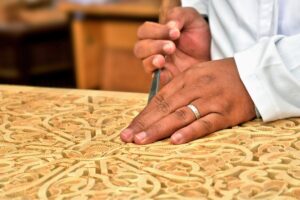
Your hands cramp. Your back aches from hunching over the bench. Cedar shavings cover your clothes. The workshop air thick with sawdust and concentration. Other craftsmen work nearby. Their hammers and saws creating rhythm. No one speaks much. The work speaks.
Three hours pass. Your piece takes shape. Not perfect. Not even close to the master’s effortless precision. But recognizably yours. Made by your hands. Using techniques unchanged for centuries in this very medina. In this very souk. Possibly this very workshop.
The final hour: finishing. Sanding. Treating the wood. The transformation from rough to refined. Your mistakes become character. The imperfections prove authenticity. Machine-made doesn’t have hesitation marks. Doesn’t have the slight unevenness where human hands adjusted, corrected, persisted.
You leave Fez medina carrying something you made. Cedar box. Inlaid panel. Small table. Whatever you choose to attempt. Heavy with more than physical weight. You touched a tradition stretching back centuries. Your hands followed the same motions countless craftsmen performed in this souk.
The master nods as you leave. No praise. No ceremony. Just the acknowledgment: you did the work.
You understand something about craft that showrooms never teach. Those perfect objects in museum cases are obscured. Making anything well requires time, patience, and the willingness to fail repeatedly in the service of eventual success.
Your piece isn’t perfect. That’s exactly the point.